Upcoming Event
 Free Newsletter

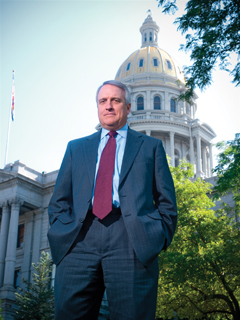
Power glide: Bill Ritter has bet his future on the new energy economy
Robert Schwab //September 1, 2009//
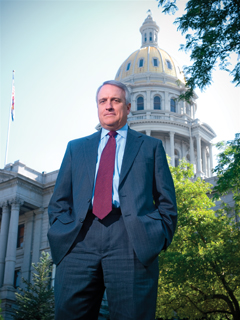
Power glide: Bill Ritter has bet his future on the new energy economy
Robert Schwab //September 1, 2009//



Abound Solar’s new factory on Interstate 25 near Loveland is the antithesis of gritty traditional manufacturing. From the white interior to the casually dressed workers making components in air-conditioned comfort, it embodies the cool, clean look of a 21st century workplace – a linchpin in Gov. Bill Ritter’s “new energy economy.”
Now 200 workers strong, Abound plans to double its work force after it completes the renovated factory. The solar panels it makes are recyclable; their development is a spinoff from research done at Colorado State University. The company is financed by $150 million in private investment.
Mark Chen, the company’s young marketing director, told reporters and other visitors on a recent tour that Abound eventually plans to produce enough solar panels annually to supply electricity to 70,000 homes for a year. The company is the epitome of the Colorado clean-tech industry Ritter has championed and continues to tout as he prepares to seek a second term.
After speaking to a business group in July, Ritter stood in the foyer of Denver’s Seawell Ballroom answering questions about his record, including whether he was jumping on the “green” bandwagon as some of his critics have charged. It was getting warm, and Ritter started pulling off his suit jacket, revealing a crisp yellow shirt, bright as the sun.
“Listen,” he said. “I was just named by some group the greenest governor in America. I didn’t set out to be that. I just got there because we keep building public policy that will support this clean energy ecosystem, this new energy economy ecosystem.”
Ritter recently visited Silicon Valley, where he met with executives at Kleiner Perkins, the California venture capital firm that hired former vice president Al Gore after he won the Nobel Prize for speaking out about global warming.
“We were talking to them about information/communication technology,” Ritter said. “And they said: ‘What we do know is Colorado has created the kind of ecosystem that we created here in the Silicon Valley around IT.’”
As Ritter sees it, his administration had a lot to do with helping to create that ecosystem.
“We came in, and we doubled our renewable energy standard; we put in place net metering,” Ritter said. “We put in place incentives for investor-owned utilities to build out transmission from places where there is renewable energy.”
The Governor’s Energy Office has a list of accomplishments Ritter’s administration claims helped fuel the evolution of Colorado as a hub for “green” energy economic development. But whether those accomplishments are enough to convince voters — especially business voters — that the governor deserves a second term, is a question that naturally follows for a Democratic elected official who already has drawn announced Republican opposition for his re-election bid in another year.
“I think he is, on the economy, extremely weak and vulnerable, looking at 2010,” said state Sen. Josh Penry, one of those announced Republican opponents. Penry has yet to win the nomination of his party and faces two other announced rivals for the nod.
But as minority leader of the Senate during the last session of the Legislature, his criticism of the governor resonated over policy debates, marking Republican targets for where the incumbent could be attacked.
Those targets include Ritter’s record on new energy.
“The problem isn’t that he has promoted renewables,” Penry said. “The problem is he’s promoted renewables at the expense of so many other important forms of energy. (He’s) appointed anti-drilling activists to the oil and gas commission; pushed a climate-change policy early in his administration that led to the closure of two coal-fired power plants, one the Arapahoe on the Front Range, one the Cameo over on the Western Slope. For this governor, energy has been zero sum. Renewables are worthy of promotion, but traditional forms of energy, he’s treated with contempt.”
Jon Caldara, president of the Independence Institute, a conservative think tank based in Golden, says Ritter has managed to anger all sides: “It takes real work to piss off both businesses and unions, but somehow Bill Ritter has mastered that.”
And on energy, Caldara is just as blunt. “It’s not a new energy economy, it’s a welfare economy, and giving tax breaks and subsidies to any company is wrong. Take, for instance, doubling the renewable mandates. That is really an incredible bit of corporate welfare aimed at the manufacturer of wind power. There’s no way that Colorado’s utilities would be doing this much wind power if it wasn’t mandated.”
But Ritter has earned respect, if not outright praise, for his clean-tech initiatives from at least one traditionally conservative quarter.
Janice Sinden, executive director of Colorado Concern, a group of mostly Republican executives from large- and medium-sized Colorado corporations that supported Ritter in his 2006 election as well as earlier moderate political initiatives like FasTracks and Referendum C, remarked on Ritter’s promotion of a new energy economy in a way that recalls the way the governor likes to tell the story himself.
“I think that the governor kind of coined the phrase ‘new energy economy,’ which we’ve seen get legs,” Sinden said. “Even (President Barack) Obama has used that term now, and so I think it’s exciting to see interest in pursuing alternative resources.
“But I think we also need to be cautious that we don’t create unreasonable expectations about using alternative fuel sources,” Sinden said. “We’re ever an oil-dependent country, and we have to moderate our expectations. It’s a laudable goal that we’re going to reduce our use of carbon-based fuels by 2020, but we need to keep that in check constantly, to see if we can get there structurally with this economy.”
{pagebreak: Page 1}
Tom Clark, executive vice president of the Denver Metro Chamber of Commerce (and as such, the state’s most powerful economic developer), said of Ritter:
“His focus on alternative energy, new-energy economy and clean tech have indeed driven lots of attention,” Clark said. “His reputation in that space has been a great asset to us in the economic-development world.”
But when asked if the governor’s work to make Colorado a national leader in clean energy will win him votes during Ritter’s 2010 re-election bid, Clark said he had to step out of his economic-developer’s role and consider different issues. “You have to ask yourself the questions that have made people uneasy, the related issues in the tax and regulatory environment that have been generated in oil and gas.
“I think that every politician today is at risk if the economy doesn’t turn around, and that includes the governor,” Clark said.
‘Ritter likes to tell the story of how Barack Obama used his phrase “new energy economy” during a campaign trip through Colorado in 2008.
“We tagged it that, the ‘new energy economy,’” Ritter said from the podium of the ColoradoBiz Minority Business Breakfast in July. “I was on a plane with Barack Obama going from Grand Junction to Pueblo, and he’d given a speech in Grand Junction, and he was talking about green energy, clean energy and job creation. I said, ‘We actually call that something. We call it in Colorado the “new energy economy.”’
Obama invoked the new energy economy in Pueblo during his next speech, Ritter said. “He mentioned it and said, ‘That’s what Gov. Ritter is doing here in Pueblo.’ … He never mentioned my name again.”
Ritter’s anecdote drew a good laugh. In the same speech to minority business owners and others, Ritter said he has made the new energy economy a “hallmark” of his administration. “We put Colorado on the map as the hub of it,” he said.
Did he? Is Colorado a hub of a new industry destined to rival the success of information technology and Silicon Valley in California? A look at a record of growth so far in Colorado suggests Ritter’s claims have some substance. But the growth of a future industry around clean tech might well be out of the governor’s hands.
“Gov. Ritter’s New Energy Economy is leading Colorado forward by creating thousands of jobs, diversifying the state’s energy portfolio, and making Colorado a nationally recognized leader in the manufacturing, production and research of renewable energy,” says a list of accomplishments put out by the Governor’s Energy Office, which is part of Ritter’s administration.
Some people might argue – and rightfully so when it comes to legislative claims that involve more than the governor’s approval – that Ritter doth claim too much.
“Sometimes I get the idea that there is a bit of a tag-along effect,” said Clint Wheelock, managing director of Pike Research in Boulder, where several clean-tech startups and initiatives have taken root. “If he sees something going on that he likes, he shows up and makes a speech.”
That’s a political impression held by a businessman whose support the governor is campaigning to sustain, and Wheelock was not the only person interviewed for this report who said something similar. The governor’s political future will be determined by his retention of the business support he had going into his race against Republican Bob Beauprez in 2006.
Yet much of that support has already been lost, giving rise to the notion that Ritter’s hopes for re-election may rest on voters’ impression of his role championing the new energy economy and their belief in its economic viability.
“I know a lot of people who have just said ‘I’m not doing that. I made that mistake once. I’m not voting for another Democrat until Roy Romer comes back,” said one Republican who asked that his political comments about Ritter not be attributed.
Romer, a three-term Democratic governor who was also popular among Republicans, did not run for re-election in 1998 and was succeeded by Republican Bill Owens, who was term-limited.
“My sense is, when it looked like Bob Beauprez’s election was going down, I think a lot of businesses … decided to back a winning horse and backed Bill Ritter,” Caldara said. “It’s not going to happen again.”
Abound Solar is among the achievements cited on the Governor’s Energy Office list. Incorporated in January 2007, the company is a commercial spinoff of 15 years’ worth of research on solar panels by professor W. S. Sampath at nearby CSU. Spinning off such research into a profit-making business is the holy grail of academic economic development.
Abound has yet to post any profits, but its trajectory toward becoming a money-making company looks as promising as its technology. And Ritter mentions it whenever he’s talking about the new energy economy. He mentions it because Abound has created 200 new jobs to staff that new economy.
wo hundred new clean-tech jobs are not, however, the answer to Clark’s demand that Ritter and the rest of the state’s politicians turn around Colorado’s economy. Abound’s goal is to employ 400 people when it finishes its rollout, adding two more production lines to the two that already exist in the retrofitted plant on I-25. Pew Charitable Trusts, a national public-policy foundation, co-hosted the tour of Abound in June to announce that Colorado had grown clean-energy jobs twice as fast from 1998 to 2007 as other jobs in the state’s economy had grown.
In a report that looked at all 50 states and the District of Columbia, Pew ranked Colorado 15th in the nation with 17,008 clean jobs in 2007, a number that had grown 1.98 percent annually since 1998, the period covered by the Pew study. Pew counted 1,778 “clean businesses” in Colorado through 2007 and $622 million in venture capital investments over the same period.
{pagebreak: Page 2}
The Governor’s Energy Office list puts the investment of Vestas Blades alone at $700 million, so investment in clean energy in Colorado is indisputably in the hundreds of millions of dollars. The major point Pew made about Colorado was that clean-tech jobs had grown 18.2 percent over the study period compared with an 8.2 percent growth rate for all jobs in Colorado over the same time frame. The study period, however, does not account for close to 150,000 overall job losses in Colorado since the economic downturn started here in late 2007.
Pike Research in Boulder, Clint Wheelock’s firm, provides clean-tech industry market analysis across the board, from algae-based biofuel to wind energy. Wheelock says it is still “very early in terms of gauging results” of the governor’s effort to build a new energy economy in Colorado because too many of the companies and initiatives are in embryonic stages of development.
He rates Colorado among the top states or cities where clean tech is growing, along with California in its Silicon Valley; Boston; Seattle/Portland; and Austin, Texas.
Wheelock appreciates Ritter’s efforts to create an industry cluster in the state, but he says real, quantitative results of those efforts might become more obvious during a second term rather than now during the governor’s re-election bid.
“He could probably rattle off eight to 10 things that he’s done, initiatives that he’s encouraged, that are pretty good proof points,” Wheelock said. “Whether, given the business community’s ambivalence about him, from what I read in the newspapers, whether that’s enough to make a difference (in a re-election bid), I don’t know.
“My take is that he seems to have done a significantly better than average job in terms of promoting the clean energy agenda, and I’m glad we have a governor who is curious about the sector and seems passionate about it.”
Ritter got a taste of what the GOP might have in store for him as he tries to ride the new energy economy to a second term when he testified before Congress over the summer.
“I’m just really kind of wondering why you are here,” Republican Oklahoma Sen. James Inhofe told Ritter during a congressional hearing July 21 on the pending Waxman-Markey climate-change bill in Washington, D. C.
When Ritter got a chance to answer — after a long-winded speech by Inhofe — Colorado’s governor sat up aggressively in his chair and said, “I’m here by invitation, so that’s why I’m here.”
The exchange, preserved on You Tube, showed Republican attacks against Ritter’s energy policies are already well under way.
Inhofe didn’t let the governor respond to his first assertion before launching into his own anti-Waxman speech.
“According to the EIA, the Energy Information Agency, Colorado’s oil-shale deposits hold an estimated 1 trillion barrels of oil, nearly as much oil as the entire world’s proven reserves. Over the long term, that could equate to hundreds of billions in economic development to Colorado,” the senator said. “Few would disagree that the passage of Waxman-Markey would effectively kill any future oil-shale production in Colorado. That’s a huge thing for the state of Colorado. I mean, that’s the biggest single economic blow that you could have in my opinion.”
Inhofe also cited a study by the Food and Agriculture Policy Research Institute stating that a typical, 1,900-acre feed-grain farm would face $11,649 in higher energy costs by 2020, $30,000 by 2050 and asked Ritter if he was supporting the Waxman-Markey bill.
When Ritter finally had a chance to speak after another Inhofe interruption, his answer was measured.
“I support a national energy policy that’s married to a national climate policy that gets at these goals that we have for greenhouse gas reductions,” Ritter said. “And I believe that, if you do that, there will be some vehicle that may not look exactly like Waxman-Markey, particularly after the Senate finishes its work. But I very much support climate legislation that is joined with a national energy policy that gets us to the greenhouse gas emissions reduction goals that are set for 2050.”
The Senate exchange reverberated through the media, provoking at least three news stories in The Denver Post and reports in new media outlets, and causing the governor to remark on the ambush during the Colorado Cleantech Industry Association launch event two days later in the Governor’s Mansion.
“I was treated a little bit roughly,” Ritter told about 125 representatives of the industry.
CCIA was started in January and had already recruited 90 members by its coming-out party in July. The event was a strong showing of business support for Ritter’s clean-energy performance, but it was a showing that was limited to the industry that benefits the most from his promotion of a new energy economy.
“Do you think you are winning any business support from doing this?” the governor was asked about the new energy economy during the short interview with ColoradoBiz in the sunny foyer of the Seawell Ballroom.
“We absolutely are winning business support,” Ritter said. “There are all kinds of individuals who have come to understand the power of a clean energy industry, the way you can create jobs.”
Janice Sinden, executive director of Colorado Concern, the group of corporate CEOs that backed Ritter in 2006, said her organization is still far away from supporting a candidate for governor in 2010, especially since the Republican nominee has not yet been chosen.
Which means the incumbent governor’s claim to business support is still in play.
Much like the claims he makes for Colorado’s achieving a new energy economy.
{pagebreak:Page 3}